 I've found a great book, that is deeply educational and entertaining in What Do You Do When Something Wants To Eat You? by Steve Jenkins. This piece of non-fiction, published in 1997, showcases animal adaptations in very clever ways. The pictures are not deeply graphic, but entertaining collages. On one page we see "If a puffer fish is in danger..." and a picture of a shark chasing a fish. When we turn the page, we see "it takes on water and swells up like a prickly balloon, making itself almost impossible to swallow."
 Friday, May 10, 2013
What Do You Do When Something Wants To Eat You?
I've found a great book, that is deeply educational and entertaining in What Do You Do When Something Wants To Eat You? by Steve Jenkins. This piece of non-fiction, published in 1997, showcases animal adaptations in very clever ways. The pictures are not deeply graphic, but entertaining collages. On one page we see "If a puffer fish is in danger..." and a picture of a shark chasing a fish. When we turn the page, we see "it takes on water and swells up like a prickly balloon, making itself almost impossible to swallow." 
Monsters Eat Whiny Children
The monster debates with family members over a whiny-child salad, a whiny-child burger, a whiny-child cake or a whiny-child vindaloo. Not to be a spoil sport, but, buy the time the settle on whiny-child cucumber sandwich, Henry and Ever are gone, "never" to whine again.
The drawings are simple and entertaining, and the monsters are not scary looking. I think children would be entertained by this tale and adults would find humor in the fact that the monsters are pretty whiny themselves.
One Cool Friend
Thursday, May 2, 2013
Second Helpings
 I might be addicted to Jessica Darling and her wit. I find her deeply engaging and entertaining and that might be why I have finished reading this second book, Second Helpings, by Megan McCafferty so quickly. Jessica Darling is perhaps one of the most likable characters in all of young adult chick-lit; yes she is flawed and makes some very poor decisions in Second Helpings. We all have lessons to learn from her mistakes.
I think I enjoy reading things from Jessica's point of view so much because I once was just like her and I identify with her problems. I was a senior in high school just like Jessica on September 11th. I struggled with finding a healthy way to react to the event. I wanted to fit in and be part of something, but not by running Cross Country, a sport which my father thought I enjoyed, just like Jessica's father. I was filled with angst over my college acceptance and hated my mailman just like Jessica. However, the fact that Jessica can still be true to herself as a best-selling book and movie based on that book become big money makers, her very pregnant sister moves back in the house, her grandmother struggles after a second stroke and Marcus Flutie is still messing with her, proves that this book provides young readers with a good role model- even though she makes some pretty big mistakes.
I believe that I mentioned that first book addressed common teen issues like sex, drinking, drugs, and the peer pressure to participate in the the activities related to sex, drinking, and drugs. Thus, this book is for mature high school students.
Frank Lloyd Wright and His New American Architecture
In Frank Lloyd Wright and His New American Architecture, I learned a great deal about the life of Wright, his inspirations, and his struggles. I felt like some of the more dirty aspects of Wright's life were hinted at, but readers were focused more on accomplishments, like building a 600 room hotel that could survive one of the greatest earthquakes in Japanese history. The Martin House is not mentioned in the discussion of Prarie architecture, but there is extensive discussion of the Robie House, which is similarly designed, but in Illinois. The book also follows all of the conventions of non-fiction by including a table of contents, glossary, timeline, further reading and even reading group activities.
Both the Badger Biography Series and Frank Lloyd Wright and His New Merican Architecture are thoughtfully crafted to inform students in a constructive way.
Friday, April 26, 2013
Sloppy Firsts
 When I went in the high school library a few days ago, the librarian recommend Sloppy Firsts by Megan McCafferty. I had told her that I liked to read books in a series and girly fiction. I think that in Sloppy Firsts she made me an excellent recommendation.
First of all, I would like to say that this is definitely a high school book. There is no way I would purchase this for a middle school library or place it in the Juvenile section of a public library. Discussion of drinking, drug use, and sex abound. In the context of the moral lesson or overall message of the book, I would think that most parents of high schools would want their daughters to read things from Jessica Darling's point of view. They would be mortified is the book was written from some of her friend's point of view. I think that the only reason that most teens would not like this book would be because it was published almost 10 years ago and the technology might feel a little off. One of the main characters has a beeper.
Sloppy Firsts is a journal written from the Jessica "Notso" Darling's point of view. Her best friend, ironically named Hope, has moved away and Jessica doesn't really enjoy the company of her other friends, whom she affectionately calls the Clueless Crew. Jessica struggles with fitting into the typical high school and understanding the culture. Her "friends" think she just has a bad attitude because Hope moved away, but a closer examination would help them find the truth. I enjoyed reading Sloppy Firsts, but I don't like where it ended, with Jessica nearly friendless, except for the one day visit from Hope. I've started reading Second Helpings so that I can change this image of Jessica in my mind.
Monday, April 22, 2013
Spring Reading
I've been busy lately, but I have managed to find some time to read. Recently, I've finished 3 books, all of which I enjoyed.
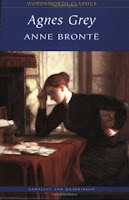 First, I went down the classic literature road and select a Bronte sister book that I have never read, Agnes Grey. Agnes Grey was written by the lesser known of the sisters, Anne. Agnes is a bit of nag, and had high expectations of her pupils from the beginning, but like in most Bronte sister literature, the people that employ the governess are a little cruel. There is always one shinning star of high morality; there is always a governess falling in love with the high moral character, who usually happens to be poor. I enjoyed reading Agnes Grey because it was brief in comparison to other similar literature and because the copy that I read had great footnotes that related the actual novel to the life of all three Bronte sisters. I would add this book to a high school library collection, because it is probably on (or near) most AP reading lists and addresses many themes that students might be required to write about on the AP Literature Exam.
 Secondly , I just finished reading a book called Wentworth Hall. I selected the book because the cover promised me that if I thought there were lots of scandals going on at the Abby, I would find this book scandals too. This tale was set in the same period as Downton Abby and I am an avid watcher. Though the story was entertaining, I will admit that even I could pick out the anachronisms here. I was entertained and found it easy to relate to, but I would not really promote this as historical fiction. It may have been set in one of the great houses of England around 1900, but I'm not sure that the relationships or actions of the characters accurately depict how the upper crust of England would have behaved at this point in time. The author, Abby Grahame, is simply trying to capitalize on a pop culture trend and write a book that might entertain a Downton Abby watcher for a few hours (I read it on a plane trip from Buffalo to Tampa). If I were to purchase the book, I would select it for a middle or high school library and recommend it to my more avid readers.
 Finally, I just finished reading the 3 book in the Bloodlines series. Bloodlines is a spin-off of the Vampire Academy series. I have been given a lot of vampire books to read in my time, probably because I named my cat after Edward Cullen. However, I usually don't read beyond the first book in most vampire series. I usually find them too predictable. This is not the case with the Vampire Academy Series or the Bloodlines spin off. The third book is called Indigo Spell, and like all the others is written by Richelle Mead. I liked Indigo Spell, because Richelle Mead really takes her readers into the thought processes of her main character, Sydney. Sydney is an Alchemist, charged with keeping the vampire world hidden from the average human. In this particular installment of the series, she is trying to overcome years of being conditioned to do what is expected of her. I think that there might be a valuable lesson to learn for most teen girls here. I also think that Mead walks very close to the edge, but never crosses, the sexual tension line that we have come to expect from vampire books. Thus, I would recommend both of these series to middle and high school librarians. I wait impatiently for each new installment.
 First, I went down the classic literature road and select a Bronte sister book that I have never read, Agnes Grey. Agnes Grey was written by the lesser known of the sisters, Anne. Agnes is a bit of nag, and had high expectations of her pupils from the beginning, but like in most Bronte sister literature, the people that employ the governess are a little cruel. There is always one shinning star of high morality; there is always a governess falling in love with the high moral character, who usually happens to be poor. I enjoyed reading Agnes Grey because it was brief in comparison to other similar literature and because the copy that I read had great footnotes that related the actual novel to the life of all three Bronte sisters. I would add this book to a high school library collection, because it is probably on (or near) most AP reading lists and addresses many themes that students might be required to write about on the AP Literature Exam.
 Secondly , I just finished reading a book called Wentworth Hall. I selected the book because the cover promised me that if I thought there were lots of scandals going on at the Abby, I would find this book scandals too. This tale was set in the same period as Downton Abby and I am an avid watcher. Though the story was entertaining, I will admit that even I could pick out the anachronisms here. I was entertained and found it easy to relate to, but I would not really promote this as historical fiction. It may have been set in one of the great houses of England around 1900, but I'm not sure that the relationships or actions of the characters accurately depict how the upper crust of England would have behaved at this point in time. The author, Abby Grahame, is simply trying to capitalize on a pop culture trend and write a book that might entertain a Downton Abby watcher for a few hours (I read it on a plane trip from Buffalo to Tampa). If I were to purchase the book, I would select it for a middle or high school library and recommend it to my more avid readers.
 Finally, I just finished reading the 3 book in the Bloodlines series. Bloodlines is a spin-off of the Vampire Academy series. I have been given a lot of vampire books to read in my time, probably because I named my cat after Edward Cullen. However, I usually don't read beyond the first book in most vampire series. I usually find them too predictable. This is not the case with the Vampire Academy Series or the Bloodlines spin off. The third book is called Indigo Spell, and like all the others is written by Richelle Mead. I liked Indigo Spell, because Richelle Mead really takes her readers into the thought processes of her main character, Sydney. Sydney is an Alchemist, charged with keeping the vampire world hidden from the average human. In this particular installment of the series, she is trying to overcome years of being conditioned to do what is expected of her. I think that there might be a valuable lesson to learn for most teen girls here. I also think that Mead walks very close to the edge, but never crosses, the sexual tension line that we have come to expect from vampire books. Thus, I would recommend both of these series to middle and high school librarians. I wait impatiently for each new installment.
Subscribe to:
Posts (Atom)

 Posts
Posts

