Thursday, December 20, 2012

The Perks of Being a Wallflower

I just finished reading The Perks of Being a Wallflower by Stephen Chbosky. I really enjoyed the book for several reasons. First of all, it reminded me of the classic, Catcher in the Rye, because of the stream of consciousness writing. Second, I thought the book was intelligently written with some life-lessons to learn. Though the characters are frequent drug users, they struggle with the same dilemmas as most high schools, trouble fitting ins or finding yourself.

I must say that I had to re-read the last 10 pages about 5 times to "get it." With the first read, I completely missed what happened. With the second read, I couldn't believe what happened. Around the 5th time, it started to sound really obvious and as if I should have figured out the dynamic from the beginning of the novel. I hope that wasn't a spoiler for anyone!

There is a recent movie with Emma Watson out and I really look forward to seeing it, probably from Redbox! Our book club is talking about using this is a book. I feel like reading this would be very thought provoking for many students and maybe help some understand the difference that they have with their peers.

Tuesday, December 18, 2012

The Queen of Kentucky

 Recently, I read Alecia Whitaker's The Queen of Kentucky.  Raised on a cattle ranch, I deeply enjoyed reading this book because the main character Ricky Jo/ Erica is a farm girl too. This book is about her finding her place at a new school. In the beginning, she is trying to reinvent herself. Part of that reinvention involves changing her name from Ricky Jo to Ericka. Part of that reinvention involves new clothes and trying out for cheerleader.

I felt that this novel had some excellent lessons for teenagers but might be difficult for kids raised in a city to relate to. I identified with the main character, but I have trouble seeing many teens learning what they should from this novel, because they might have trouble understanding some of Erica's life experiences, like working in a tobacco field all summer to earn spending money.

Living in Buffalo, NY, I might not buy this for my high school library. Were I still living in Little Rock, AR, I wouldn't hesitate.

Monday, December 10, 2012

Jane: A modern retelling of Jane Eyre

First of all, I am a sucker for a retelling of a story that I already know and love. Just like I enjoyed reading Tiger Lilly by Jodi Lynn Anderson, I deeply enjoyed reading Jane by April Lindner. The plot line is basically the same as Jane Eyre by Charlotte Bronte. Jane is hired to be a nanny by someone in a different social class than here, in this case a rockstar. They fall in love and the secrets in the attic have a very dramatic and heart-breaking effect on their relationship and the reader.

Jane would be appealing to readers who love and enjoyed the classic. It would also bring the classic to a more readable level to today's teenagers. They will be able to understand Jane's attraction to the rockstar Nico Rathburn a little better than Jane's attraction to the surly lord of the manner, Mr. Rochester. Where the Victorian novel only evolved into heavy breathing, the modern retelling ventures further into an adult relationship and might not be appropriate for all classroom libraries or library settings. This address a few mature issues and requires the reader to understand the deeper meanings behind a character's action.

Tuesday, December 4, 2012

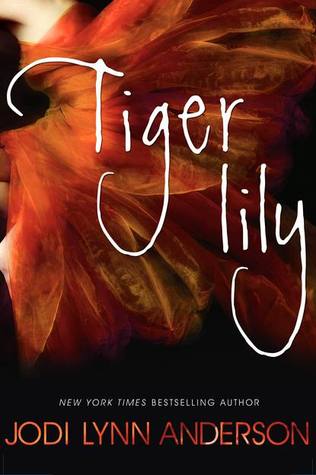
Tiger Lilly

I've just finished reading Tiger Lilly by Jodi Lynn Anderson. I selected the book because I enjoyed reading the Peaches series, but I quickly discovered that this book was nothing like the previous series I had read. Instead of the story being about southern women growing up, this is a retelling of a children's favorite in a more adult way.

In this case, the narrator is Tinker Bell and she has a small obsession with Tiger Lilly, the strong Indian girl from the Peter Pan classic. There are a few differences between this tale and what one might expect from a retelling of Peter Pan. First, the story focuses on Peter and Tiger Lilly's love story. There is more of a focus on what life is like in Neverland for the different groups of people who live there. Tiger Lilly is a Sky Eater, a tribe of people who grow to a certain age and stop growing.

I liked this book for several reasons. I had to keep adjusting what I knew about the story of Peter Pan. Anderson changes a few details. For example, the flying is a myth, mermaids are evil and will drowned you, and Smee is a crazed serial killer.

The book also tackles important issues. For example, Tick Tock, Tiger Lilly's adopted father, believes that each person has parts of man and women inside them. When the tribe, prompted by an Englisher who is visiting the village, turns against him because he is "displeasing" God, issues of acceptance and kindness are addressed.

I would recommend this book to anyone who had previously enjoyed Jodi Lynn Anderson or was a fan of the dystopian fiction a few months ago. I see several different retellings of classics coming about.

Thursday, June 7, 2012

The Breadwinner

I just finish reading what might be my new favorite book The Breadwinner by Deborah Ellis. This book was written before the war in Afghanistan and helps to explain the powerlessness of women in that country. Parvana, a young girl, lives in Afghanistan under the Taliban. This is a place where women can not leave their homes without their husbands, much less get an education. Women cannot enter shops to buy groceries or goods for their families. They must stand outside and shout their order into the shop owner. Parvana's father, who was educated in England, is arrested. When he is no longer there to support the family she must cut her hair and pose as a young boy. Then, she can sit in the marketplace and read and write letters for people. Students have an opportunity to learn much from Parvana and her experiences. This would make a great whole class novel. While many students in 4th through 7th grade might understand the content of the book, others, who have a small cultural experience might struggle to understand the concept of such a restrictive culture. Thus, a teacher or parent might need to explain the context of the tale a little.

Sunday, March 25, 2012

Water for Elephants

I recently picked up a copy of Water for Elephants because I felt a little culturally out of the loop for not reading it or seeing the movie. Before I start, I will say that I would not select this book for a young adult collection. It is about two things that I know very little about from my own personal experience, living in a circus and struggling with poverty during the Great Depression. I would recommend this book for a supplemental reading list if I high school Social Studies class were studying the Great Depression.
Jacob starts the story with a very charmed life, just like many Americans started life at the beginning of the Great Depression. As a Vet student at Cornell, he is pulled from one of his final classes and told that his parents have died in a car accident. He quickly discovers that his parents were hit hard by the Great Depression and have put themselves into extreme debt to pay for his Ivy League education.
Lost and slightly delirious by the prospect of his looming "future," Jacob finds himself on a circus train, a circus in need of a vet. Any observant reader can tell that he is going to fall in love with the show's star before Jacob even realizes it. However, to find out if he wins her away from her husband, the unbalanced master of animals on the show, you'll have to read it.
When I watched the movie, I was disappointed by the differences. There were more flashbacks to Jacob as an old man in a nursing home in the book and I felt that made him a more sympathetic character. However, both the book and the movie are worth your time to read and enjoy. Interesting lessons for readers can be found in how people struggle and cope with poverty. I felt like a complete jerk as I read this one on the beach! The reality of life for a little person or a struggling alchoholic in the Great Depression are stark and should impact any reader.

Saturday, March 24, 2012

The Hunger Games Trilogy

The Hunger Games Trilogy has captured the attention of readers and non-readers alike. The series starts with The Hunger Games and Katniss Everdeen volunteering to go in to the sickest reality television show you can possibly imagine. Collins brings in an interesting love triangle that includes fellow district 12 tribute Peta and Gale, a hunting partner to Katniss. Throughout the series, which includes Catching Fire and Mockingjay, this love triangle is what makes the story interesting, beyond the obvious government gone-wrong/ save the world theme.
I was wildly entertained and I deeply enjoyed this series. As a matter of fact, I read it in a week. However, I have a serious problem with the way that the first book ends. SPOILER ALERT. Because of this ending, an attempted suicide, I have a problem recommending this book to kids and with the popularity that it has maintained over the last few years. As an educator, I am upset with librarians and English teachers alike because I feel like we have missed another opportunity to discuss a serious issue.
When Bella attempted suicide in the Twlight series, we barley mentioned it. In that series, immature readers might have even missed that she was trying to kill herself. However, no one can miss the attempted suicide in The Hunger Games. All action stops and they talk about it. I hate that this is treated so lightly by teachers and I'm not sure that most parents would even know that it is there.
Now that I have said my piece there, I have to say that I thought the movie was great. I had problems with the fact that Madge is not a character in the movie, the bodies are not picked up during the games, and Lenny Kravitz felt like a strange casting choice to me. However, I imagine that I will see it again and deeply enjoy it again.
Finally, Dystopian literature in this manner is doing social studies teachers a favor. Readers are learning to question government. It is so obvious to readers that what the Capital is doing is wrong that drawing parallels about wrongs from our own government is a natural jump.